Infrared Emitters for Plastic Welding
Non-contact infrared heating that melts joint surfaces cleanly before parts are pressed together.
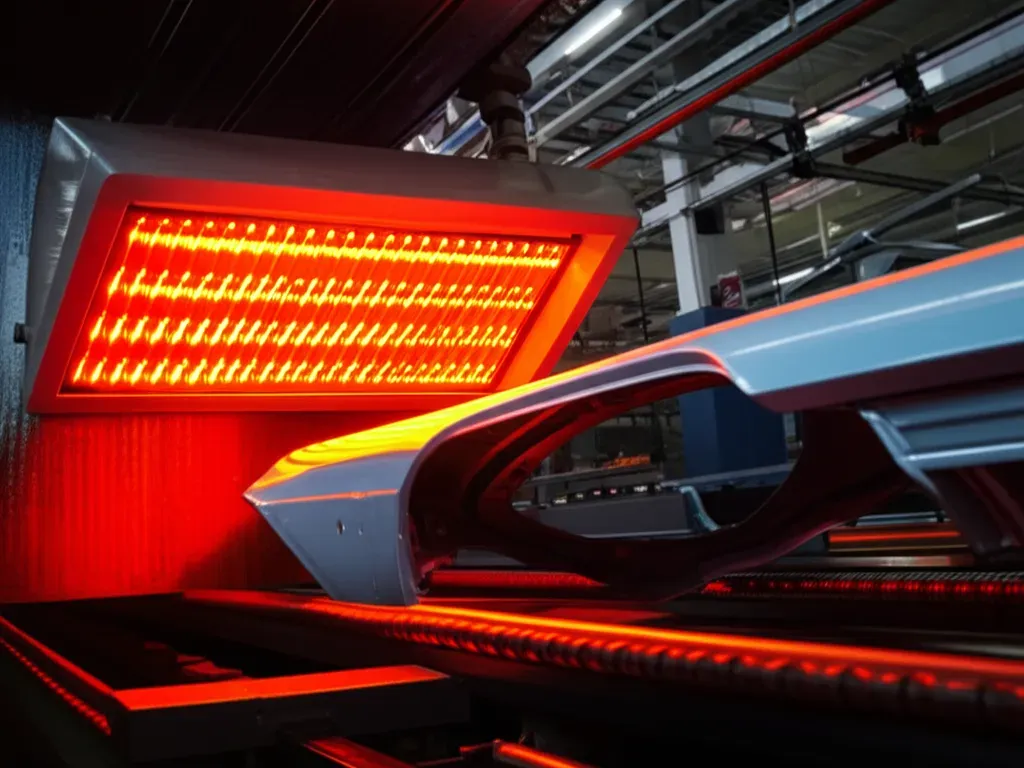
How infrared welding works
In infrared welding, emitters shaped to the weld seam heat the joint surfaces of two thermoplastic parts without touching them. When the surfaces have melted to the required depth, the emitters move away and the parts are pressed together until the weld cools. Because nothing touches the melt, there is no material sticking to a hot plate and no stringing.
- Non-contact: no sticking or stringing as with hot-plate welding
- Clean, strong and repeatable welds
- Short heating times with fast-responding emitters
- Suited to glass-fibre-reinforced and high-temperature plastics
Which emitter for which plastic
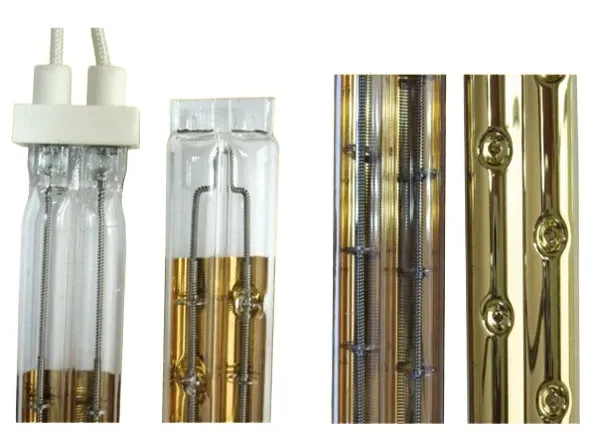
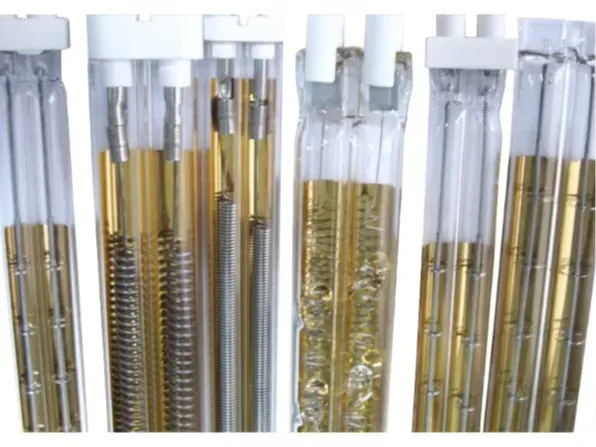
Shortwave and twin-tube emitters with gold reflectors deliver concentrated power and switch in about a second, which gives short cycle times. Carbon and medium wave emitters are absorbed closer to the surface by most plastics and give a more controlled melt layer for thin walls and sensitive materials. Emitters are often bent to follow the weld contour so that the whole seam heats evenly.
Typical parts
Infrared welding is widely used for technical and automotive components, for example:
- Automotive lamp housings, air ducts, tanks and filters
- Fluid-handling parts and housings in PP and PA
- Appliance and electronics housings
- Medical and filtration components
Which infrared heater fits?
| Heater type | Wavelength & response | Best for |
|---|---|---|
| Shortwave quartz (IR-A) | Peak about 1.0–1.4 µm, full power in 1–2 s | Fast cycles, thick walls, glass-fibre-reinforced plastics |
| Carbon / fast medium wave | Peak about 2 µm, full power in 1–2 s | Controlled surface melt with fast on/off |
| Medium wave quartz (IR-B) | Peak about 2.4–2.8 µm, full power in about a minute | Thin walls and heat-sensitive plastics |
| Ceramic (IR-C, long wave) | Peak about 3–5 µm, heats up in several minutes | Slow processes; rarely used for welding |
Wavelengths are typical values for each emitter type.
Recommended products



Frequently asked questions
Which plastics can be infrared welded?
Most thermoplastics, including PP, PE, PA, ABS, PC and PBT, also with glass-fibre reinforcement. The emitter type and heating time are matched to the material and wall thickness.
What is the advantage of infrared welding over hot-plate welding?
Infrared heats the joint without contact, so no molten plastic sticks to a hot plate and there is no stringing. This gives cleaner welds and less maintenance.
Can infrared emitters be shaped to my weld contour?
Twin-tube and special shortwave emitters can be bent to follow a contour. Send us the part geometry or drawing to discuss a special emitter.
Do you supply replacement emitters for existing welding machines?
Yes. Send the emitter dimensions, shape, wattage and voltage, or the old emitter, and we will match it.
Related
Other applications
Tell us about your process
Share the material, line speed and the heater or lamp you use today. Our engineers in Chennai will recommend the right infrared solution.