Infrared Heaters for Thermoforming & Plastic Sheet Heating
Ceramic and quartz infrared heaters that bring plastic sheet evenly to forming temperature.

What a thermoforming heater has to do
In thermoforming and vacuum forming, a plastic sheet is heated until it is soft enough to be drawn over a mould. The sheet must reach forming temperature evenly across its whole area and through its thickness without the surface scorching. Uneven heating shows up as thin corners, webbing, marks or parts that do not hold their shape.
Heater banks are therefore built from many individual heaters arranged in zones, with the edges and corners usually run hotter than the centre to compensate for heat lost at the clamp frame.
Matching the wavelength to the plastic
Most thermoplastics such as ABS, PS, PET, PP, PE and PMMA absorb infrared strongly at wavelengths above about 3 µm. Ceramic infrared heaters radiate mainly in this long-wave range, so their energy is absorbed efficiently by the sheet. That is why ceramic heaters are the traditional choice for thermoforming, especially for thicker sheet.
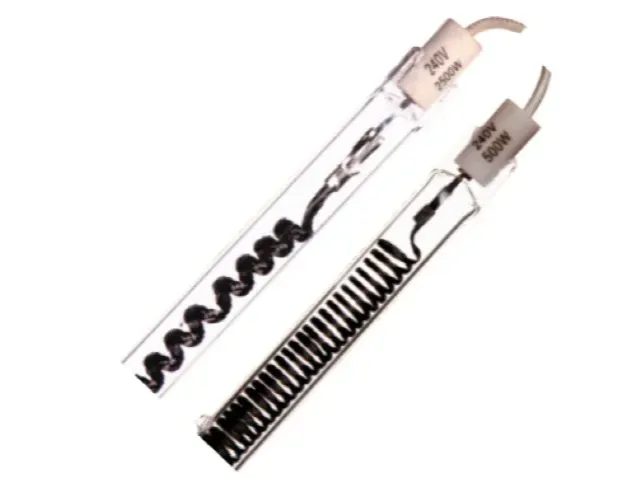
Medium wave quartz heaters respond faster and suit machines that switch heaters on and off between cycles or that form thinner gauge sheet. Shortwave and carbon heaters are used where very fast heat-up is needed, for example in high-speed thin-film lines.
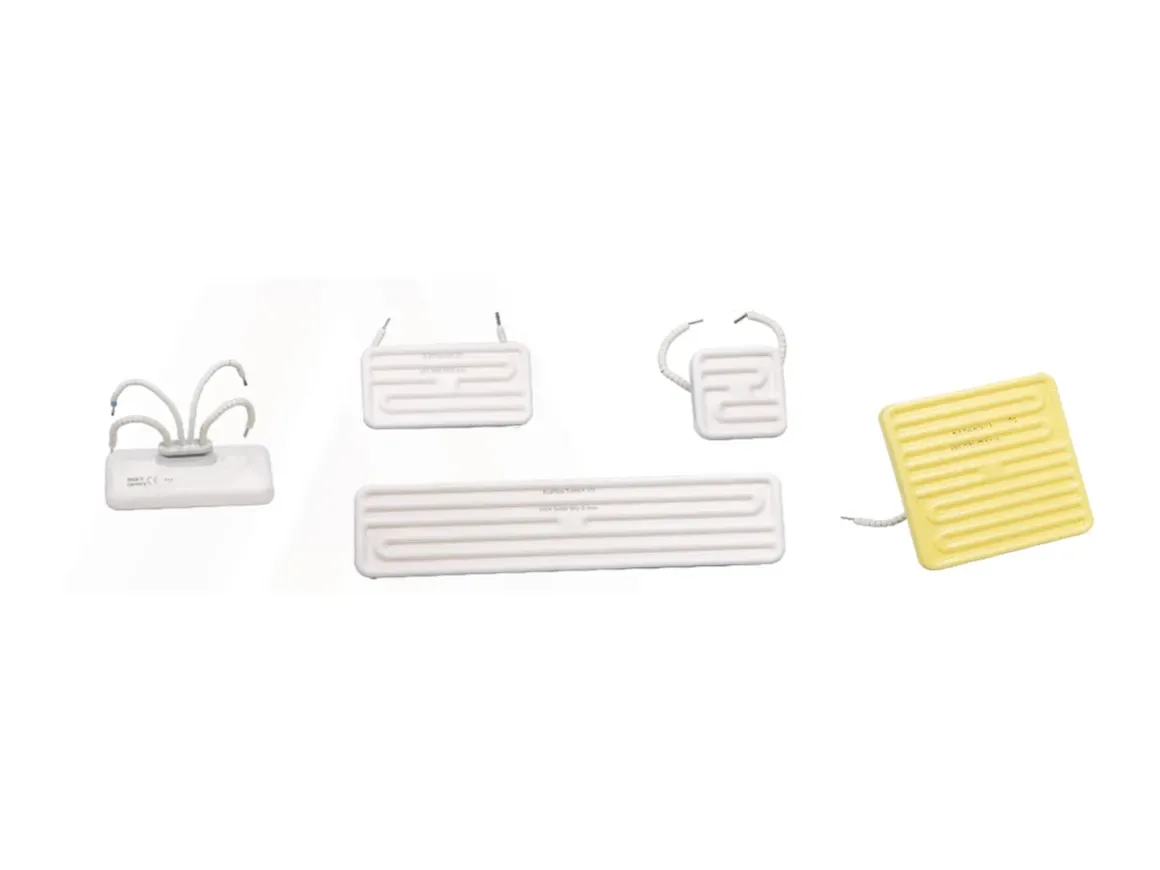
- Ceramic heaters: robust, even radiation, ideal for thick sheet and long dwell times
- Medium wave quartz: faster response, less heat stored in the heater, good for thin gauge
- Zone control with thermocouple-type ceramic heaters for repeatable profiles
Ceramic heaters made in Chennai, and Elstein
We manufacture ceramic infrared heaters in Chennai and also supply the Elstein range of ceramic emitters, so most standard sizes and power ratings for thermoforming heater banks are available, including heaters with built-in thermocouples for closed-loop zone control.
Replacing heaters in an existing machine
Replacement heaters must match the face size, connection type, wattage and voltage of the originals so that the zone layout and the controller settings stay valid. Send us the details of the heaters in your machine and we will recommend matching or upgraded types.
Which infrared heater fits?
| Heater type | Wavelength & response | Best for |
|---|---|---|
| Ceramic (IR-C, long wave) | Peak about 3–5 µm, heats up in several minutes | First choice for most thermoforming: absorbed well by plastics, very even |
| Medium wave quartz (IR-B) | Peak about 2.4–2.8 µm, full power in about a minute | Faster cycles and thin gauge sheet |
| Carbon / fast medium wave | Peak about 2 µm, full power in 1–2 s | Very fast heat-up for thin films |
| Shortwave quartz (IR-A) | Peak about 1.0–1.4 µm, full power in 1–2 s | Special cases only; can over-penetrate thin clear sheet |
Wavelengths are typical values for each emitter type.
Recommended products



Frequently asked questions
Which infrared heater is best for thermoforming?
For most plastics and sheet thicknesses, ceramic infrared heaters are the best fit because plastics absorb their long-wave radiation efficiently and the heating is very even. Medium wave quartz heaters are preferred for faster cycles and thinner sheet.
Do you manufacture ceramic infrared heaters?
Yes. We manufacture ceramic infrared heaters in Chennai and also supply the Elstein ceramic heater range.
Can ceramic heaters be controlled zone by zone?
Yes. Heaters with built-in thermocouples allow closed-loop temperature control per zone, which keeps the heating profile repeatable from cycle to cycle.
What information do you need to quote replacement heaters?
The heater face dimensions, connection type, wattage, voltage and the number of heaters per zone. A photo of the existing heaters or the machine model also helps.
Related
Other applications
Tell us about your process
Share the material, line speed and the heater or lamp you use today. Our engineers in Chennai will recommend the right infrared solution.